| | The International Meeting of Bonsai and Suiseki has become in the years, the most imitated manifestation in all Europe, but that is distinguished itself for the wealth of the contents, the quality and the organization of the program introduced. In the 2004 edition it proposes for the art of bonsai extraordinary guests, who will give proof of their technical ability through unknown techniques to the vanguard: Japanese master Toshio Ishii one of the first teaching of art bonsai, premonitory to the teaching increased to the world of the enthusiasts, and Master Cheng Cheng Kung great expert of Juniperus, conveiver and inventor of the method Si-Diao, thanks to which the carved dried wood on bonsai appears incredibly natural.  TOSHIO ISHII TOSHIO ISHII
Toshio Ishii is born the 19 October 1940 in the city of Maebashii - Gunma Prefecture - approximately 100 km to the north west of Tokyo.
First of six brothers, soon after to have attended the school, he begins to help the father in the activity of planning and preparation of garden. The meeting with Tokijiro Kato, already well-established bonsai master who entertained relationships trades with the father, marks the beginning of its approach to this ar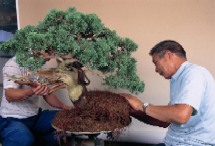 t. To those times living as bonsai professional was not simple, for who he was forced to relegate the studies finalizes to the own formation, and the job on the plants, to the evening hours, after days work in gardening. Precursor of the modern times, at the age of 24 years, in the surge of the popular interest for the Bonsai, begins to hold course for the enthusiasts, which caused the dissaproval of master Kato, little inclined to one amassed expansion of the Bonsai, and the consequent temporary break of their relations. His singular method to teach the art of Bonsai, however, earns much popularity among the participants of the “Ishii Bonsai Club”, so much to make grow local distributions in all Japan. Thanks to this particular approach to the Bonsai, very soon becomes one of the more popular and loved masters of Japan. t. To those times living as bonsai professional was not simple, for who he was forced to relegate the studies finalizes to the own formation, and the job on the plants, to the evening hours, after days work in gardening. Precursor of the modern times, at the age of 24 years, in the surge of the popular interest for the Bonsai, begins to hold course for the enthusiasts, which caused the dissaproval of master Kato, little inclined to one amassed expansion of the Bonsai, and the consequent temporary break of their relations. His singular method to teach the art of Bonsai, however, earns much popularity among the participants of the “Ishii Bonsai Club”, so much to make grow local distributions in all Japan. Thanks to this particular approach to the Bonsai, very soon becomes one of the more popular and loved masters of Japan.
To confirmation of the great creativity of Ishii, there are its numerous bonsai works, of unquestionably innovative character, 68 of which worked, during his long career, expressly for the prestigious Kokufu Exhibition.
His unique strength lies in his ability to recognize in raw material, such as that from nursery or collected in nature, the potential of development in masterpieces bonsai and in the assiduous application of the techniques in the process of increase of the plants. Specialized in the shaping and the restyling, its fields of interest are a lot wide and included Juniperus, deciduous trees, flower and fruit species. He has participated to various convention that took place in the various Countries, among which United States, Spain, England, Korea and Taiwan. | | CHENG CHENG KUNG
Born and grew in the countryside. Loving scenery and living in Taiwan, where with full of beautiful mountains and streams, makes him have many opportunities to climb up high mountains to directly observe trees in their natural environment. Such impressing experiences, no doubt, established the first basis for his future bonsai work. At an occasion in 1980, he read some treatises concerning about the bonsai art. At that time, he was fully inspired and 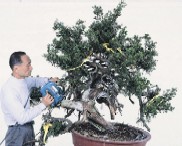 reverenced to it - the ingenious art of combination of natural and artificial. Since that, he frequently decorated his house with lots of bonsai. Many relatives praised and encouraged him to engage in such field. Under their support and his own aspiration, “bonsai creator” has gradually been his lifetime career. One of the important issues for bonsai creation is how to catch the specific characteristic and spirit of each species. For example, Juniperus - the most famous species - is grown in the high altitude mountain, steep topography and barren land. Affected by the violent geography and climate, it always forms natural imperishable relics “sarira” (Sanskrit), shari (Japanese) on its trunk and branches. Sarira is a dead part but is an awarding sign of conquering difficulties. Moreover, its branches develop with philosophy of “share and allowance” instead of “competition”. Seem dead on one side (yin-negative) but still living on the other (yang-positive); tender but never yielding; share but never competing; Juniper, in fact, fully reveals the value of overcoming and accommodation in adverse circumstances. Thus, the deepest art is how to present such features in our Juniper bonsai. In order to break the limitations set by the employment of mechanical tools and to avoid the cutting artifact left behind, a special technique of “Si-Diao (silk-carving)” is adopted. The word of “Si-Diao” means a specific carving skill to obtain the “sarira” without any manmade trace just like silk, and to twist trunk and branches in an optimum way. The treated Bonsai exhibits not only simple beauty in form, but also the imperishable durability through years of weathering as well as the silk-like fine noble fiber and texture. Since he decided to throw himself into the unknown field of bonsai, he has faced many difficulties and obstructions as no instructor to guild him. At that time, he did not disappoint nor gave it up. Now, he would like to share and communicate his past experiences to you, and hope you can learn each other. The other difficulties will arise certainly, however, once if you see the nature, which is created by your hands, you will feel indescribable delight and feel all your diligent striving is worthy. He does an actively participation in international bonsai Convention to Philippine, Singapore, Mainland of China, South Africa. He was invited also to the 4th WBCM in Germany and the 6th Asia-Pacific Bonsai Convention in Malaysia. He teaches bonsai art in Bonsai Art Association of Taiwan. reverenced to it - the ingenious art of combination of natural and artificial. Since that, he frequently decorated his house with lots of bonsai. Many relatives praised and encouraged him to engage in such field. Under their support and his own aspiration, “bonsai creator” has gradually been his lifetime career. One of the important issues for bonsai creation is how to catch the specific characteristic and spirit of each species. For example, Juniperus - the most famous species - is grown in the high altitude mountain, steep topography and barren land. Affected by the violent geography and climate, it always forms natural imperishable relics “sarira” (Sanskrit), shari (Japanese) on its trunk and branches. Sarira is a dead part but is an awarding sign of conquering difficulties. Moreover, its branches develop with philosophy of “share and allowance” instead of “competition”. Seem dead on one side (yin-negative) but still living on the other (yang-positive); tender but never yielding; share but never competing; Juniper, in fact, fully reveals the value of overcoming and accommodation in adverse circumstances. Thus, the deepest art is how to present such features in our Juniper bonsai. In order to break the limitations set by the employment of mechanical tools and to avoid the cutting artifact left behind, a special technique of “Si-Diao (silk-carving)” is adopted. The word of “Si-Diao” means a specific carving skill to obtain the “sarira” without any manmade trace just like silk, and to twist trunk and branches in an optimum way. The treated Bonsai exhibits not only simple beauty in form, but also the imperishable durability through years of weathering as well as the silk-like fine noble fiber and texture. Since he decided to throw himself into the unknown field of bonsai, he has faced many difficulties and obstructions as no instructor to guild him. At that time, he did not disappoint nor gave it up. Now, he would like to share and communicate his past experiences to you, and hope you can learn each other. The other difficulties will arise certainly, however, once if you see the nature, which is created by your hands, you will feel indescribable delight and feel all your diligent striving is worthy. He does an actively participation in international bonsai Convention to Philippine, Singapore, Mainland of China, South Africa. He was invited also to the 4th WBCM in Germany and the 6th Asia-Pacific Bonsai Convention in Malaysia. He teaches bonsai art in Bonsai Art Association of Taiwan. | |

